
News and Blogs
Follow our latest product updates, certifications, partnerships, and milestones as we scale sustainable materials. From research breakthroughs to real-world adoption, these updates reflect how our technology is creating impact.
Published by Sarvesh Poddar
27 May 2026
5 mins read
EPR (Extended Producer Responsibility). Packaging waste is finally brand's responsibility.
What is EPR and whom does it affect?
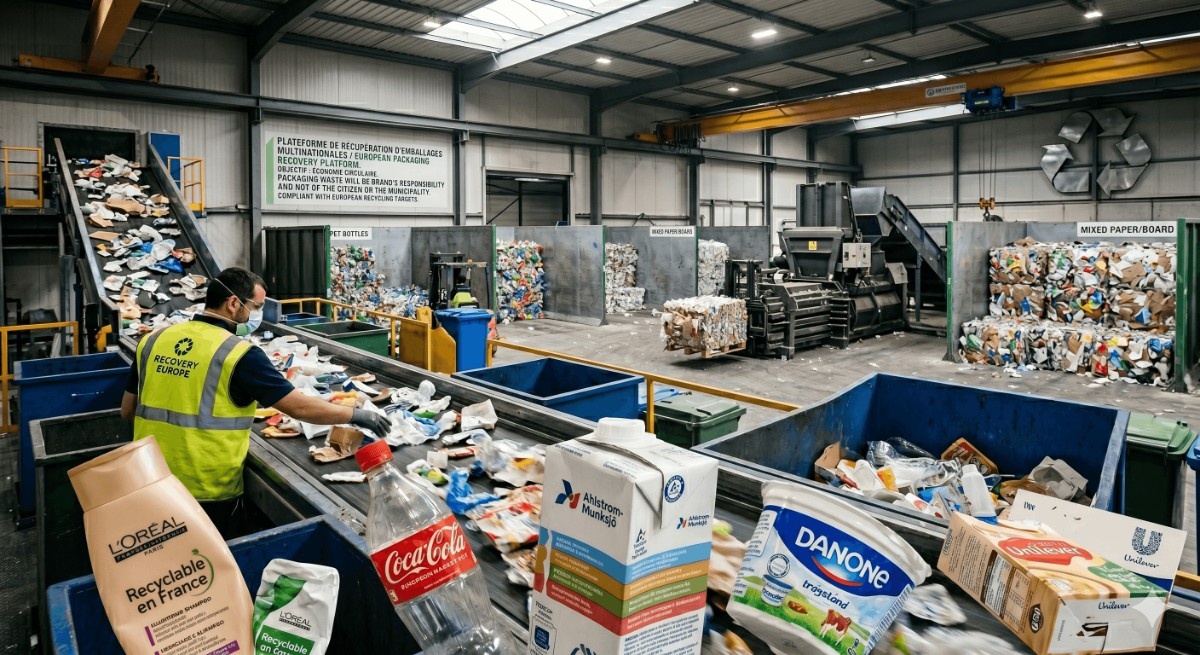
The image above is artificially generated, as you might have guessed, but the content is written by an actual human. What’s written on the board in the background, which might be hard to read, is erringly true: under EPR, the brand is responsible for its packaging, not the customer or the municipality where it ends up as garbage.
Does EPR (Extended Producer Responsibility) affect us? It depends on your lens.
As a product user: Yes. The packaging we see often claims to be recyclable, but it most probably doesn’t end up in the recycling stream because it doesn't fit existing plant processes. It might be technically recyclable, but factors like chemical binders, multiple layers, or low recycled content mean it is not practically recyclable, even if the law permits the label.
As a packaging convertor: Yes. Brands pass the financial pressure up the supply chain. Because brands need to lower their EPR fees, convertors must adapt their manufacturing lines, move away from complex multi-layer designs, and source compliant, easily recyclable materials to retain their clients.
Specific laws around EPR in Europe & US
In Europe, the PPWR (Packaging and Packaging Waste Regulation) forces brands to adopt built-in EPR. Key pointers of this European legislation include:
- A mandate that all packaging must be recyclable by 2030.
- Strict "eco-modulation" fees that financially penalize non-recyclable designs and reward sustainable ones.
- Holding e-commerce platforms legally liable if their third-party sellers fail to comply with EPR registration.
The resulting charges for a Swiss food giant, for example, are around €440 million per year. This includes Base EPR Fees, EU Plastic Levies, and sustainability surcharges. These collected funds finance recycling infrastructure and education.
An article from a US-based chemist tracking biomaterials highlighted how this is unfolding stateside. Oregon’s EPR law took full effect in July 2025 to shift the waste burden from local municipalities to the companies bringing the packaging to market. Similar regulations are progressing in California, Colorado, Maine, Maryland, and Minnesota.
The Oregon law is administered by the Circular Action Alliance (CAA), an NGO with founding members like Walmart, Amazon, and Coca-Cola. Central to the regulation are per-pound fees intended to incentivize easily recyclable materials:
- Paper: Corrugated cardboard is 3¢/lb; poly-coated paperboard is 32¢/lb.
- Metal: Aluminum cans are 6¢/lb; aluminum aerosol cans are 73¢/lb.
- Plastic: Clear PET bottles are 17¢/lb; expanded polystyrene (like fast-food clamshells) is $1.94/lb.
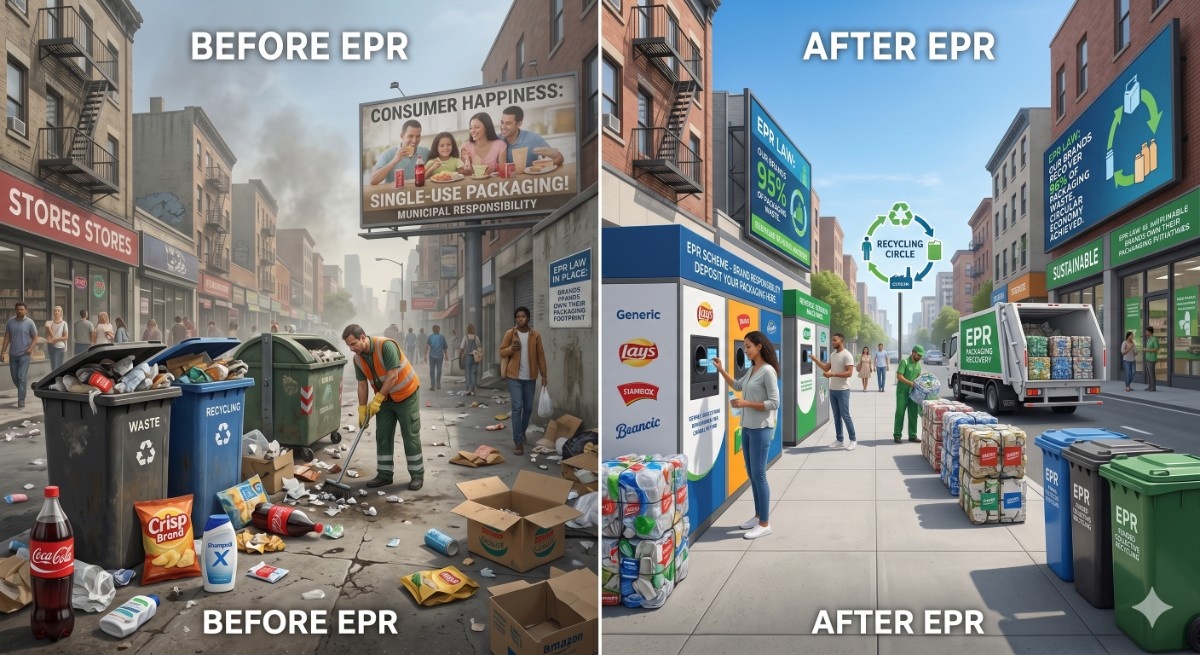
Will the waste crisis be resolved?
When widely implemented EPR regulations are positioned to significantly alter packaging waste management and track recycling rates in the coming years.
Think of it this way, It is too late if poorly developed packaging are let out to be flooded in the market. The transition has to happen at the manufacturing end as it is a easy control a few hundrerdd manufacturers/suppliers than billions of users.