
News and Blogs
Follow our latest product updates, certifications, partnerships, and milestones as we scale sustainable materials. From research breakthroughs to real-world adoption, these updates reflect how our technology is creating impact.
Published by Sarvesh Poddar
26 June 2026
5 mins read
The high cost of water: Is paper packaging industry ready for solid-state coatings
The math behind the current state of coating system
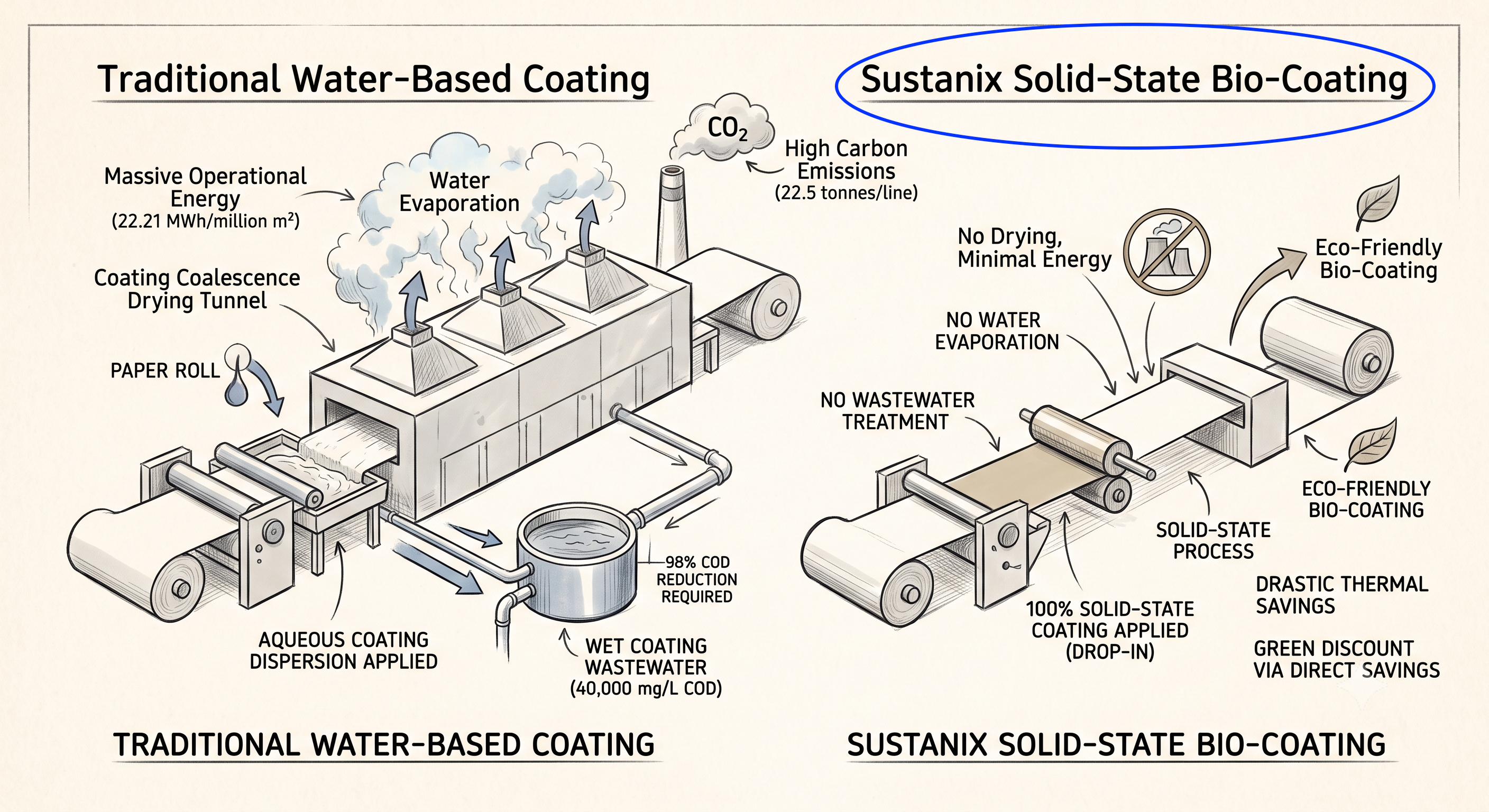
To coat 1 million square meters of paper, an average packaging converter evaporates roughly 18,667 liters of water, consuming 22.21 MWh of electricity in the process. The irony is stark: the industry uses massive operational energy boiling off a water carrier just to make a paper surface resistant to water.
Beyond the energy drain, finishing a run introduces a costly secondary headache. Flushing out the tanks, pumps, and pans creates highly concentrated polymeric wastewater, commonly known as "white sludge" This milky suspension of liquid coating resins carries a massive Chemical Oxygen Demand (COD) concentration of 10,000 mg/L to 40,000 mg/L. Compared to the maximum permissible EU municipal discharge limits of 75 mg/L to 125 mg/L, mills are forced to run intensive on-site wastewater treatment plants to execute a 97% to 98% COD reduction.
Fundamentally, traditional liquid coating systems spend 70% of their logistical weight and 90% of their operational energy simply transporting and boiling off a carrier fluid.
Why water-dispersant coating became the industry standard in the first place
Water-dispersion became the industry standard out of infrastructure necessity. When the Clean Air Act (1970) and European VOC Directives (1990) forced a retreat from volatile organic solvents, the industry pivoted to aqueous systems. Because hydrophobic polymers cannot dissolve in water, formulation chemists engineered emulsion polymerization—suspending microscopic polymer spheres (100–200 nm) inside water, stabilized by surfactants.
When applied to paper, this water must be actively driven off in a drying tunnel. As the water evaporates, capillary pressure forces the suspended spheres to deform, compress, and fuse into a continuous barrier film—a process known as film coalescence.
Paper mills and converters already owned massive liquid-handling assets built for clay-slurry pigment coatings or solvent systems (gravure, flexo anilox, blade coaters, and air-knives). Aqueous acrylics matched the exact viscosity, surface tension, and fluid dynamics of these existing machines. The industry didn't have to retool; they just changed the liquid in the tank.
Industry has transitioned before and now awaits the next one: 100% solid-state coating
The infrastructure workaround of the 1990s no longer fits the energy and emission realities of today. Sustanix has developed a 100% solid-state bio-coating that completely eliminates the water carrier while remaining 100% plant-based.
Crucially for mill veterans, this technology does not require a specialized machinery overhaul. It is designed to function as a drop-in solution on existing rotogravure, flexography, or size press lines—minus the massive energy draw of the drying hoods.
By eliminating water evaporation and the subsequent "white water" treatment cycle, the system achieves a gross reduction of approximately 22.5 metric tonnes of CO₂ per assembly line, all while matching strict commercial benchmarks for water, water vapor, and grease barriers.
This transitions the sustainability conversation away from a capital penalty. By removing the carrier fluid entirely, the industry gains a "green discount" via direct thermal energy and wastewater savings, rather than absorbing a green premium.